Trace Moisture Measurement in PET Bottle Manufacture
The importance of trace moisture measurement in PET bottle manufacture
What is PET?
Polyethylene terephthalate (PET) is a thermoplastic widely used for food and beverage packaging, valued for its strength, clarity and barrier performance. Its integrity, however, depends on tightly controlling resin moisture, as even trace water can trigger hydrolytic degradation during high-temperature processing.
Because PET is hygroscopic, it readily absorbs moisture from ambient air. When wet pellets are heated for melting, that moisture reacts with the polymer and breaks down its molecular structure. The result is reduced molecular weight, weaker mechanical properties and poorer durability in the finished bottle.
The impact of trace moisture in processing
Moisture issues typically present as brittleness from polymer breakdown, haze or discolouration from hydrolysis, and bubbles formed by vapour during moulding. Beyond appearance, these defects compromise the barrier to oxygen and CO₂, shortening shelf life and affecting product safety. Scrap, slower throughput and higher costs quickly follow.
To avoid this, PET resin must be dried to below 50 ppm (0.005%) before moulding, commonly using desiccant dryers. Continuous verification of these trace levels is essential throughout production.
Prevention and compliance
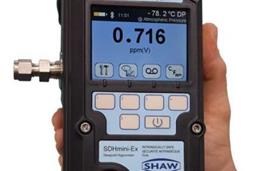
Inline capacitance sensors provide rapid readings at the dryer outlet and flag early signs of poor performance. Integrated with alarms and feedback loops, they prevent wet resin reaching the extruder or injection unit. Portable dewpoint meters should be used for routine checks to confirm dryer operation.
Sensors capable of ppm-level detection give real-time assurance of resin quality, enabling proactive intervention. Support this with rigorous dryer maintenance, optimised airflow to prevent condensation and controlled material handling to minimise ambient exposure.
Standards such as ISO 15512 (water content determination) and ASTM D7191 (PET resin quality) offer clear limits and validation protocols. Working to these guidelines supports consistent product performance, regulatory compliance and customer confidence.
For guidance on trace moisture measurement in PET applications, contact the Shaw team.
Visit the Shaw Moisture Meters (UK) Ltd website for more information on Trace Moisture Measurement in PET Bottle Manufacture
ENQUIRY FORM