Why the Shaw Ultra High Capacitance Aluminium Oxide Sensor Matters
Why our ultra-high capacitance aluminium oxide sensor is designed for long-term stability
A dewpoint instrument is only as good as its sensor.
If the sensor drifts, responds slowly or degrades in demanding conditions, even the best electronics cannot provide a trustworthy reading.
Shaw’s ultra-high capacitance aluminium oxide sensor is designed to provide stable, responsive trace moisture measurement across demanding industrial applications.
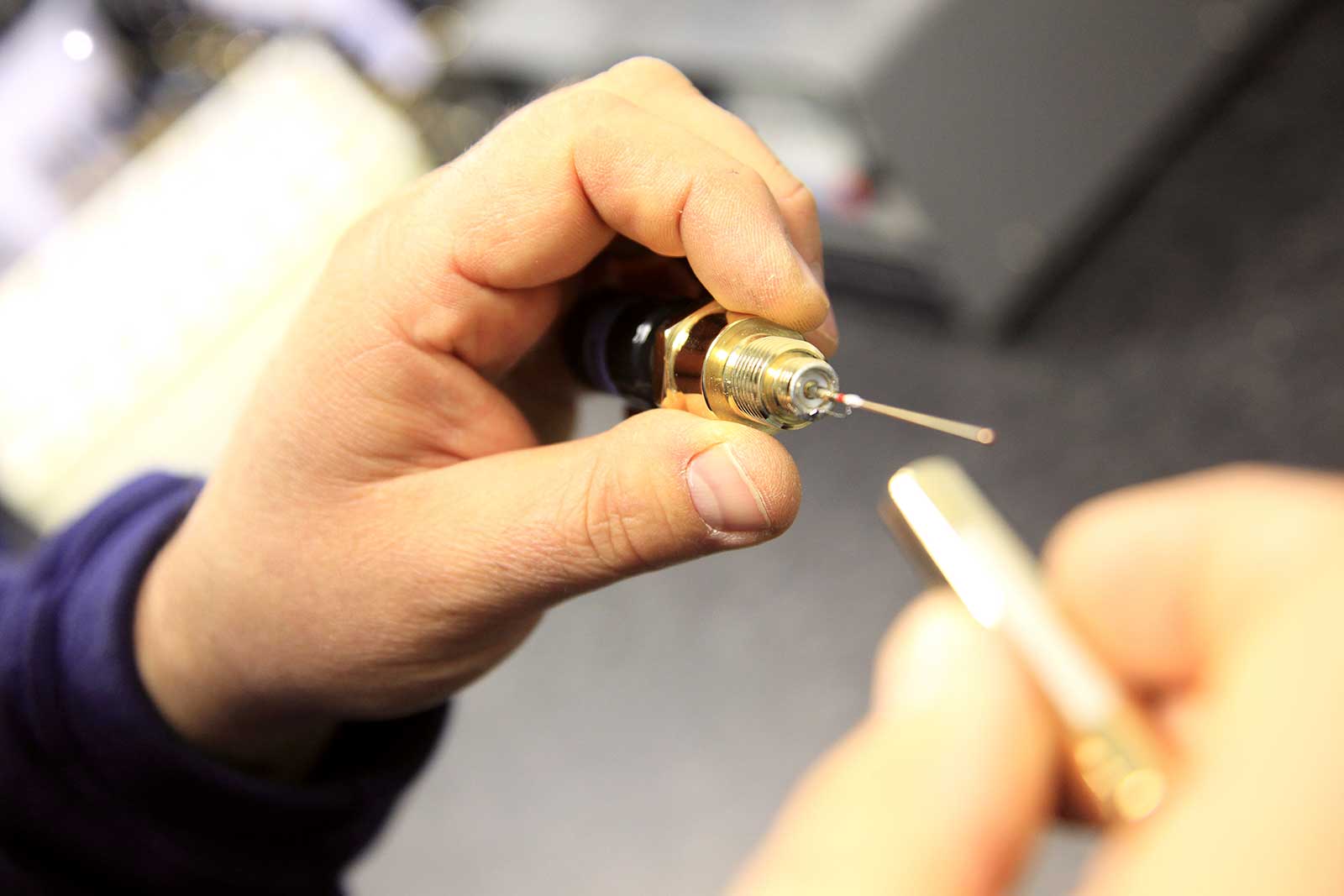
Its performance is shaped by the way Shaw manufactures the sensor, particularly the layers and pores that interact with water vapour.
What makes the Shaw sensor different?
Capacitance-based aluminium oxide sensing is a well-established method for measuring trace moisture.
However, not all sensors using this technology provide the same long-term performance.
At the heart of the Shaw sensor is the Base Insulating Layer.
This layer provides the foundation for the moisture-sensitive oxide above it, and its structure, thickness and consistency influence how the sensor responds over time.
Shaw’s manufacturing process carefully controls the formation of this layer and the pore geometry within the sensing structure.
This precision helps the sensor maintain a predictable response as moisture levels change.
Reducing dry-end drift
In continuous low-moisture applications, such as compressed air downstream of a desiccant dryer, sensor stability is particularly important.
A sensor with an uneven or porous Base Layer can retain moisture in secondary capillary paths.
Over time, this moisture may be released slowly, contributing to calibration changes and a progressively less accurate dry-end reading.
Another possible effect is a flat-spot response, where the sensor may react slowly when moisture levels increase again after a prolonged period of dry operation.
This can become a serious problem when the measurement needs to identify moisture breakthrough at an early stage.
A falsely reassuring dry reading may delay corrective action while the process is already becoming wetter.
To address this, Shaw manufactures the sensor with a precisely formed and evenly constructed Base Layer.
This design helps minimise the secondary moisture storage that can contribute to dry-end drift and slow recovery.
Selective measurement of water vapour
Many industrial gases contain components that could potentially affect a moisture measurement.
Hydrogen applications, for example, require careful consideration of both the gas being measured and the water vapour present within it.
The Shaw sensor’s controlled pore geometry provides selectivity for water vapour.
Hydrogen molecules are small enough to enter the pores, but their low dielectric constant produces very little capacitance change.
Larger polar molecules, such as methanol, may have a stronger electrical effect but can be restricted by their physical size.
Water vapour occupies the important middle ground.
It is small enough to enter the pores and sufficiently polar to produce a measurable capacitance change.
As a result, the sensor responds primarily to moisture rather than producing a combined response to every component within the gas stream.
AutoCal supports long-term accuracy
Alongside sensor design, Shaw’s AutoCal function provides a practical way to check and adjust the instrument in the field.
The sensor has a predictable saturation point at the upper end of its calibrated range.
When exposed to a gas that is wetter than this point, such as ambient air, the sensor reaches a repeatable condition that can be used as a reference for a span check.
From there, the instrument can adjust to that known point, helping compensate for gradual sensitivity changes caused by contamination or extended operation.
For many applications, users perform this check periodically, typically every two to three months, in line with the instrument’s operating instructions and their own quality procedures.
Designed for demanding applications
Taken together, the Shaw ultra-high capacitance aluminium oxide sensor provides:
-
Fast and predictable response during both drying and wetting conditions
-
High selectivity for water vapour
-
A measurement range from 0.001 ppm to 0.2% by volume
-
Dewpoint measurement from approximately −100 °C to +20 °C, depending on instrument configuration
-
Flow-independent measurement
-
Low hysteresis and low temperature coefficients
-
Operation across a wide range of temperature and pressure conditions
-
Minimal routine maintenance
-
Compatibility with hazardous area applications where the relevant instrument configuration is certified to ATEX and IECEx requirements
Calibration you can trust
Sensor design is only one part of measurement confidence.
The calibration behind the instrument is just as important.
Every Shaw hygrometer is supplied with a Certificate of Calibration.
Shaw’s calibration process is traceable to national and international humidity standards at the UK’s National Physical Laboratory through the company’s absolute primary reference hygrometers.
Shaw’s quality management system is also independently certified to ISO 9001:2015.
Together, stable sensor construction and traceable calibration provide confidence that the instrument can continue to deliver reliable measurements, not only at commissioning but throughout its service life.
The sensor is the real differentiator
Displays, outputs and software all contribute to the usability of a moisture instrument.
However, they all depend on one fundamental requirement: the sensor must accurately reflect the moisture content of the gas.
Shaw has designed and manufactured dewpoint and trace moisture measurement equipment since 1960.
Its ultra-high capacitance aluminium oxide sensor is designed to provide stable, selective and responsive measurement across industrial applications, including demanding low-moisture and hazardous area environments.
To find the right Shaw sensor and instrument configuration for your application, contact the Shaw Moisture Meters applications engineering team.
Visit the Shaw Moisture Meters (UK) Ltd website for more information on Why the Shaw Ultra High Capacitance Aluminium Oxide Sensor Matters
ENQUIRY FORM