The Hidden Cost of Moisture in Ethylene Feed Gas
Why dryer breakthrough is easy to miss – and expensive to ignore
In polyethylene production, ethylene feed gas is purified before it reaches the reactor.
Oxygen, carbon monoxide and water are removed because they can interfere with polymerisation catalysts and affect product quality.
Water is one of the most important contaminants to control.
At parts per million levels, it can reduce catalyst activity, consume co-catalyst and contribute to changes in reactor performance and resin grade.
However, in many plants, the first obvious sign that a molecular sieve dryer has stopped protecting the process is an upset at the reactor.
Trace moisture measurement in ethylene feed gas gives operators earlier visibility.
Rather than waiting for catalyst activity, production rate or resin quality to change, they can detect rising moisture as a lead dryer approaches saturation.
Why water causes problems downstream
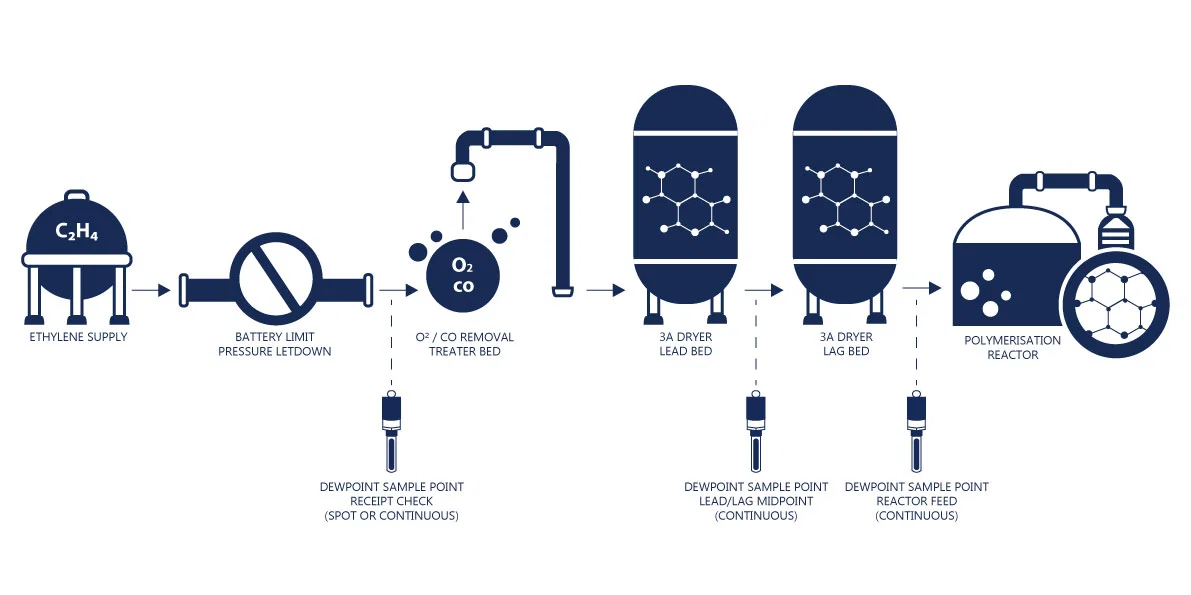
Ethylene feed treaters commonly use 3A molecular sieve dryers to remove water.
These are often installed as lead and lag beds, with the lead bed carrying the main drying load and the lag bed providing protection against breakthrough.
The risk is that a saturated bed does not always give an obvious warning.
Once the adsorption front reaches the outlet of the lead bed, water can pass into the lag bed and, if the problem is not addressed, eventually reach the reactor.
The consequences can include:
-
Reduced activity of Ziegler-Natta, chromium and metallocene catalysts
-
Increased consumption of aluminium-alkyl co-catalysts such as triethylaluminium (TEAL)
-
Greater difficulty maintaining production rate and polymer properties
-
Resin produced outside target grade specifications
-
Increased chemical use as operators compensate for changing reactor conditions
The measurement point that makes the difference
Measuring moisture at the reactor inlet confirms whether water has already reached the process.
By that stage, the opportunity to intervene early may have passed.
A more useful measurement point is between the lead and lag dryers.
A rising moisture trend at this midpoint can show that the lead bed is beginning to break through while the lag bed is still protecting the reactor.
This gives operators time to switch beds and begin regeneration in a controlled way.
For this reason, the lead-lag midpoint is often the primary location for continuous dewpoint measurement in ethylene feed gas.
What accurate measurement requires
Trace moisture measurement at these levels is not simply a matter of installing an analyser and taking a reading.
Ethylene sampling needs careful handling to make sure the result reflects the gas stream rather than moisture held within the sample system.
Key considerations include:
-
Sampling in the vapour phase
-
Using short stainless-steel sample lines
-
Heating the pressure-reduction stage where required to prevent condensation
-
Purging new or disturbed lines and allowing readings to stabilise
-
Recording sample pressure alongside the dewpoint reading
-
Using intrinsically safe equipment in Zone 1 or Zone 2 ethylene areas
Because pressure affects the indicated dewpoint, a reading should always be interpreted alongside the conditions under which it was taken.
Turning dryer breakthrough into a planned event
With the correct measurement point and a reliable dewpoint transmitter, dryer breakthrough does not need to become a reactor upset.
A rising trend at the lead-lag midpoint can prompt a planned bed switch and regeneration before water reaches the reactor.
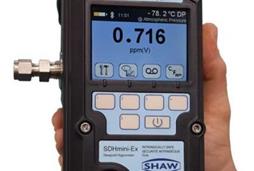
Portable intrinsically safe hygrometers also have an important role.
They can be used to check incoming ethylene at the battery limit, verify a regenerated bed before it returns to service and investigate moisture problems after maintenance or changeout.
Download the full application note
Our application note, Dewpoint Measurement in Ethylene Feed Gas, explains where to measure, how to avoid common sampling errors, how to interpret dewpoint readings at trace levels and how moisture trends can support planned dryer bed changes.
Download the Dewpoint Measurement in Ethylene Feed Gas application note for further information.
Contact us
If you have any questions or would like advice on measuring trace moisture in your application, please contact us. Our team are here to help.
Visit the Shaw Moisture Meters (UK) Ltd website for more information on The Hidden Cost of Moisture in Ethylene Feed Gas
ENQUIRY FORM