Lithium-ion Dry Room Zones Explained
Why each lithium-ion dry room zone has its own dewpoint
Lithium-ion dry rooms divide production into different zones because each stage of cell manufacture has a different tolerance to moisture.
Each zone can therefore operate to its own dewpoint target, often referred to as a tier, rather than requiring the entire facility to run at the driest possible condition.
This article explains the main production zones, why their dewpoint targets differ and how conditions can be measured accurately in each area.
Why lithium-ion dry rooms are split into zones
Moisture affects lithium-ion cells in different ways at each stage of production.
Before electrolyte is introduced, water vapour can react with the surface of high-nickel cathode materials and contribute to residual lithium compounds such as lithium hydroxide (LiOH) and lithium carbonate (Li₂CO₃).
Electrodes and separators can also adsorb moisture, which may then become sealed inside the cell during assembly.
Once electrolyte is present, trace water can react with the lithium hexafluorophosphate (LiPF₆) salt commonly used in liquid electrolytes.
This decomposition pathway can produce hydrofluoric acid (HF), which may corrode cell components, damage electrode interfaces and contribute to capacity fade and increasing impedance over time.
Argonne National Laboratory’s BatPaC cell assembly model uses a maximum dry room dewpoint of −40 °C, equivalent to approximately 130 ppm(v) water vapour at atmospheric pressure.
More sensitive process stages, particularly electrolyte filling, often require much drier conditions.
Producing drier air also requires more energy.
Maintaining a space at −60 °C dewpoint requires substantially more dehumidification and desiccant regeneration energy than maintaining it at −35 °C.
Running the entire plant at the driest specification would therefore increase energy use and cost unnecessarily.
Instead, each zone can be controlled to a dewpoint that matches the moisture sensitivity of the process taking place within it.
The main lithium-ion dry room zones
Coating and calendering
During coating and calendering, operators coat electrodes with slurry, dry them and then pass them through rollers to set the required thickness and density.
High-nickel cathode materials can readily absorb moisture, which may increase residual lithium content.
In some slurries, absorbed moisture can also increase viscosity or contribute to gelation, affecting coating quality and process stability.
Once the electrodes have been dried, they need to remain dry until cell assembly.
Stacking or winding
During stacking or winding, operators layer or wind electrode sheets together with separators to form the internal cell structure.
At this stage, the cell remains open to the dry room atmosphere, so the electrodes and separators can continue to adsorb moisture.
Any water picked up at this point may enter the sealed cell and later react with the electrolyte.
This makes stacking and winding more moisture-sensitive than general electrode handling.
Electrolyte filling and sealing
Electrolyte filling is usually one of the driest and most tightly controlled areas of a lithium-ion battery plant.
The open cell and electrolyte are directly exposed to the room atmosphere, so dewpoint needs to be controlled and measured continuously.
Dewpoint measurement confirms the condition of the atmosphere surrounding the electrolyte and open cell.
It does not measure the water content of the electrolyte itself.
Laboratories typically use Karl Fischer titration to measure water content in a liquid sample.
Airlocks and material transfer areas
Personnel movement, material transfer and door openings can all introduce significant moisture loads into a dry room.
For this reason, plants often monitor airlocks between zones separately and carry out additional spot checks.
See our article on dry room airlock moisture control for more information.
Typical dewpoint tiers
Dewpoint targets vary according to cell chemistry, process stage, cell design, production throughput and plant layout.
The following ranges are indicative rather than universal specifications.
| Zone | Typical Dewpoint | Approximate Moisture Level at 1 atm |
|---|---|---|
| Coating, calendering and general electrode handling | −30 °C to −40 °C | Approximately 380 to 130 ppm(v) |
| General cell assembly, stacking and winding | −40 °C to −50 °C | Approximately 130 to 39 ppm(v) |
| Electrolyte filling and sealing | −50 °C to −60 °C or lower | Approximately 39 to 11 ppm(v) or less |
These conversions are approximate because converting dewpoint to ppm(v) depends on pressure.
At atmospheric pressure, −40 °C corresponds to roughly 127 ppm(v).
For high-nickel chemistries, solid-state development lines or lithium metal systems, some areas may require even lower dewpoints.
There is no single published regulation that sets one dewpoint limit for all lithium-ion battery manufacturing.
Cell and process engineering teams set the appropriate target according to active material, electrolyte and finished-cell moisture specifications.
Measuring each zone
A reading at the dehumidifier supply cannot show whether every individual production zone is meeting its own specification.
For this reason, plants install fixed dewpoint transmitters in each zone to monitor the conditions that the zone is actually maintaining.
Sensors should be positioned close to the process but away from supply diffusers, doors and other local disturbance sources so they measure the air to which the product is exposed.
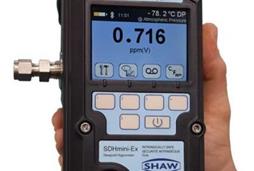
Engineers can also use a portable hygrometer to verify fixed instruments, investigate excursions and trace a moisture problem back to its source.
Our application note, The Importance of Dewpoint Measurement in Lithium-Ion Battery Manufacture, explains moisture mechanisms and recommended measurement locations in more detail.
If you would like help selecting suitable instruments for each zone of your dry room, get in touch with our team.
Visit the Shaw Moisture Meters (UK) Ltd website for more information on Lithium-ion Dry Room Zones Explained
ENQUIRY FORM