Food Packaging Gas Systems
Why can dewpoint differ between the nitrogen header and packaging manifold?
Dewpoint measurement in food packaging gas systems does not always produce the same reading at every point in the line.
This article looks specifically at why readings can differ between the nitrogen header and the packaging manifold.

For a broader view of the complete gas system, see our application note on trace moisture measurement in food packaging.
A continuous dewpoint reading at the nitrogen header confirms the condition of the gas entering the packaging hall.
A portable measurement at the packaging manifold answers a different question: has that condition been maintained through the downstream distribution system?
If the manifold gives a wetter reading, the difference should not simply be treated as an inconsistency between instruments or measurement locations.
It can provide useful evidence about where the gas system stopped maintaining the condition established upstream.
For food packaging engineers, comparing these two measurement points can help distinguish a central gas quality problem from moisture introduced closer to the packaging line.
What does the header reading confirm?
A continuous reading at the nitrogen or carbon dioxide distribution header establishes the condition of the central gas supply as it leaves the buffer receiver.
If the reading is acceptable, the gas is dry at that location and at that time.
It provides an ongoing quality record for the packaging hall and creates a useful reference against which individual lines can be compared.
What it does not prove is that every connected machine receives gas in exactly the same condition.
Between the header and the package, the gas may travel through branch pipework, hoses, quick-connect couplings and manifolds.
Each of these sections becomes part of the measurement question.
Why might the point-of-use result be different?
A difference between the header and manifold readings directs attention towards the downstream distribution path.
A hose left open between production runs can allow ambient moisture to enter.
A quick-connect coupling may expose the line when disconnected.
Opening a manifold during a changeover creates another opportunity for moisture to enter a system that previously showed a dry reading.
The surrounding temperature can also matter.
If gas pipework passes through a colder part of the plant and the pipe wall approaches the pressure dewpoint of the gas, condensation can form.
The header reading may remain acceptable because it represents conditions upstream of that colder section.
In each case, the source gas may have met the required condition.
The change occurred during distribution.
Why compare measurement locations?
A single dewpoint result tells an engineer about one measurement point.
Comparing two results begins to show what happened between those locations.
If the header and manifold readings are similar, the gas condition has been maintained through that part of the distribution system.
If the point-of-use result is wetter, the investigation can focus on the relevant branch, hose, coupling, manifold or temperature condition instead of immediately treating the problem as a central nitrogen generation fault.
This does not remove the need to monitor the dryer outlet or generator feed.
Wet compressed air can reduce the separation efficiency of the carbon molecular sieve in a pressure swing adsorption nitrogen generator.
An upstream measurement therefore remains important for identifying a dryer or feed air problem.
For more information about monitoring at this point, see our application note on dewpoint measurement in compressed air dryers.
The distinction is diagnostic.
An upstream reading helps establish whether dry gas was produced.
A point-of-use reading helps establish whether that condition was maintained.
When is a manifold check particularly useful?
A portable check is particularly useful after the distribution system has been opened or altered.
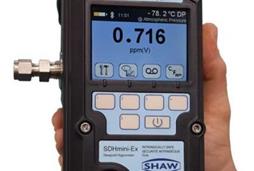
Portable dewpoint meters and hygrometers are well suited to this type of spot check at multiple locations across a distribution system.
A line changeover, disconnected hose, opened manifold or work on the gas pipework can all alter conditions downstream of the fixed monitoring point.
Long or exposed pipe runs can also be worth checking, particularly where they pass through colder areas of the production environment.
The aim is not simply to collect another reading.
It is to compare conditions at locations that answer different engineering questions.
Dewpoint measurement in food packaging: from header to investigation
Continuous and portable dewpoint measurements perform complementary roles.
Dewpoint measurement in food packaging gas systems works best as a comparison rather than as a single check.
The continuous header reading provides the reference for the central supply.
A portable measurement at the flow-wrap or FFS manifold tests whether an individual line still reflects that reference.
When the readings differ, the investigation can focus on the distribution route between them.
This is why measuring dewpoint only at the nitrogen source can leave a blind spot.
It confirms the starting condition, but not necessarily the condition of the gas entering the package.
The next question is where fixed and portable measurements should be positioned across the complete gas system.
Visit the Shaw Moisture Meters (UK) Ltd website for more information on Food Packaging Gas Systems
ENQUIRY FORM