Dry Room Humidity Measurement
Dewpoint, RH or ppm(v)?
Dry room humidity measurement is commonly expressed in three ways: dewpoint, relative humidity (RH) and parts per million by volume, written as ppm(v).
All three describe the moisture condition of a gas, but they are not equally useful in a lithium-ion battery dry room.
Specifications may use different units. Some process or chemistry limits are given in ppm(v), while plant and zone targets are often expressed as dewpoint.

Here is what each unit means, how they relate and which measurement is usually the most practical.
What each unit measures
Above 0 °C, dewpoint is the temperature at which a gas, when cooled at constant pressure and water vapour content, becomes saturated with respect to liquid water and condensation can begin.
A lower dewpoint means less water vapour is present.
If the moisture content stays constant, the dewpoint remains approximately constant even when the room temperature changes.
This makes it useful as a control and specification parameter for dry rooms.
Below 0 °C, the reference may be the saturation curve over ice, in which case the value is commonly called frost point.
Many instruments still use the term ‘dewpoint’ as a general label for sub-zero measurements, so it is worth checking which reference curve is being used.
At very low moisture levels, dewpoint and frost point can differ by several degrees.
Relative humidity is the ratio of the actual water vapour partial pressure to the saturation vapour pressure at the current air temperature, expressed as a percentage.
Because saturation vapour pressure changes with temperature, the same moisture content will produce a different RH reading at 20 °C and 25 °C.
Specialist RH instruments can measure very low values, but in a dry room RH becomes a small and temperature-sensitive number.
For very dry atmospheres, dewpoint or ppm(v) is generally more practical for specification and comparison.
ppm(v) expresses the water vapour mole fraction, meaning the number of water vapour molecules per million molecules in the gas mixture.
At a specified total pressure, ppm(v) can be converted to dewpoint or frost point.
The conversion depends on pressure and on whether the calculation uses the ice or liquid water saturation curve.
How the three units relate
At approximately 101.325 kPa, the following approximate relationships apply.
The sub-zero values use the ice saturation reference and the RH values are calculated at an air temperature of 20 °C.
| Frost Point (°C) | Approx. ppm(v) | Approx. RH at 20 °C |
|---|---|---|
| -30 °C | 375 | 1.6% |
| -40 °C | 127 | 0.55% |
| -45 °C | 71 | 0.31% |
| -50 °C | 39 | 0.17% |
| -60 °C | 10.7 | 0.05% |
In the table above, frost point is shown for sub-zero conditions. Many instruments and specifications refer to these values as dewpoint.
Values may vary slightly depending on the vapour pressure equations and reference convention used.
At approximately 1 atm, 100 ppm(v) corresponds to around −42 °C when calculated using the ice saturation curve.
The exact temperature depends on pressure and on whether the ice or liquid water reference is used.
The RH column shows one of the limitations of using relative humidity in a very dry room.
The range from −40 °C to −60 °C corresponds to less than 1% RH at 20 °C.
An instrument that cannot resolve small fractions of a percentage point may therefore struggle to distinguish between different dry room specifications.
Which unit should a dry room use?
For most dry room control and comparison, dewpoint is the most practical unit to specify and monitor.
Dewpoint remains a meaningful representation of moisture content when room temperature changes and can be converted to ppm(v) where a process limit is specified in that form.
RH can still be useful in other environmental and clean room applications, but it is generally less convenient as the primary specification for an ultra-dry battery manufacturing environment.
Two details should be stated in any specification:
-
Whether sub-zero values use the ice or supercooled liquid reference
-
The total pressure at which ppm(v) is specified or calculated
Dry room humidity measurement in practice
Dewpoint should be measured continuously at representative locations in each zone, not only at the dehumidifier supply.
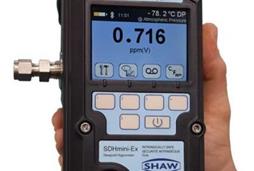
Fixed dewpoint transmitters can provide continuous readings in selected zones, while a portable hygrometer can help engineers verify fixed instruments during commissioning, maintenance and troubleshooting.
Sampling method, pressure, sensor location and stabilisation time should all be considered when comparing readings from different instruments.
We explain why a single supply reading may not be enough in Why Measuring Dewpoint at the Dehumidifier Isn’t Enough.
Our application note Dewpoint Measurement in Lithium-Ion Battery Manufacture covers moisture mechanisms and measurement locations in greater detail.
If you would like help choosing dewpoint instruments for your dry room, please get in touch with our team.
Visit the Shaw Moisture Meters (UK) Ltd website for more information on Dry Room Humidity Measurement
ENQUIRY FORM