Dewpoint meter vs transmitter
Dewpoint meter vs transmitter: which do you need?
The right choice depends on whether you need occasional spot checks or continuous monitoring, and where the reading needs to go.
A portable dewpoint meter is suited to multi-point checks, while an inline analyser or transmitter provides continuous measurement.
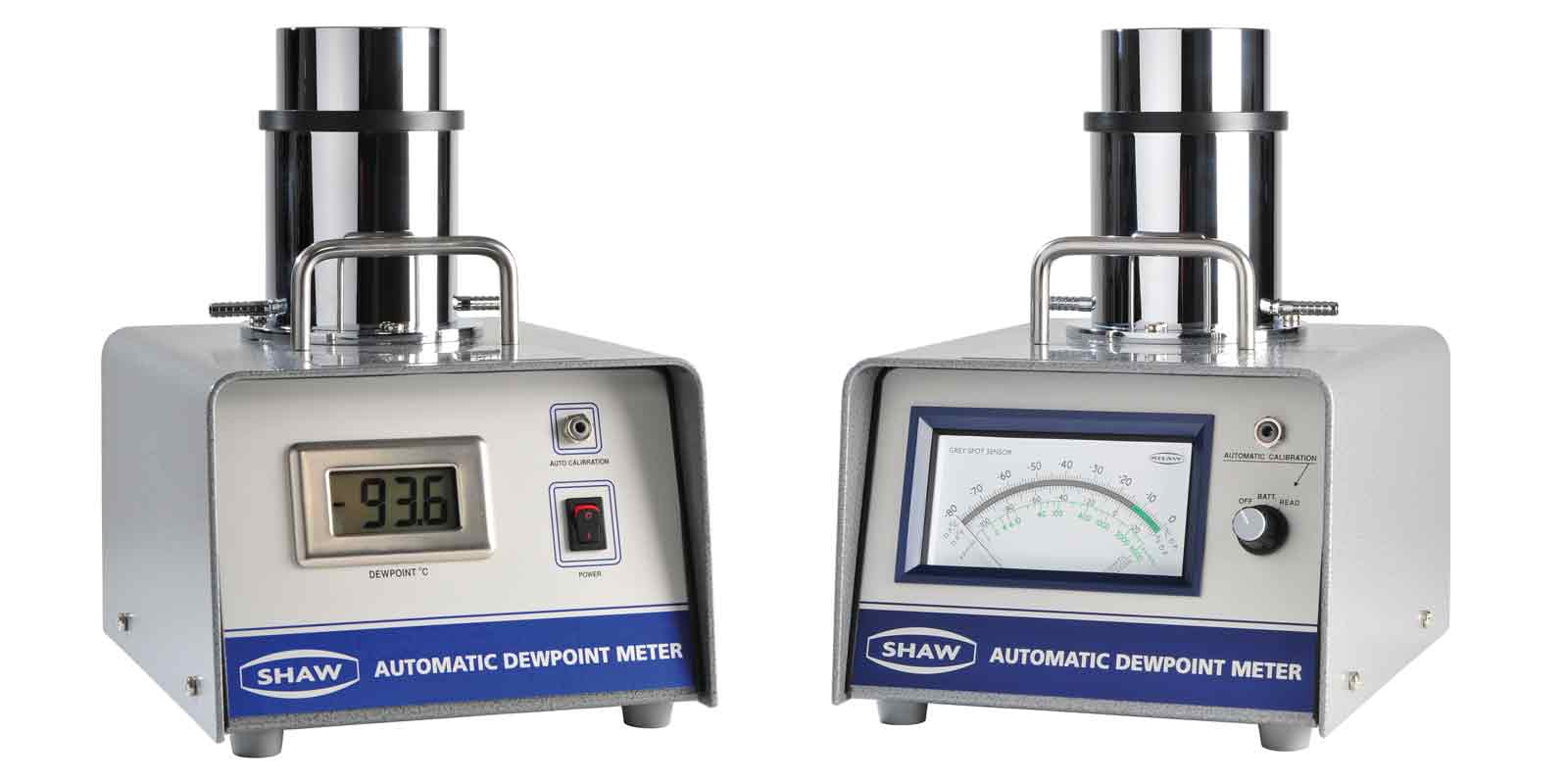
Every SHAW dewpoint instrument uses ultra-high capacitance aluminium oxide sensing technology.
Dewpoint meter vs transmitter: the key difference
A dewpoint meter gives the user a direct moisture reading.
A portable dewpoint meter can be carried between sample points for spot checks, while an inline moisture analyser provides continuous local indication, alarms and control system outputs.
A dewpoint transmitter does not usually include its own display or alarms.
Instead, it sends a 4–20 mA signal to an existing PLC, SCADA or BMS, which then displays, logs and alarms on the measurement.
In simple terms:
-
Choose a portable dewpoint meter for occasional checks at several locations
-
Choose an inline dewpoint analyser for continuous monitoring with local indication and alarms
-
Choose a dewpoint transmitter when your control system already handles display, data logging and alarms
Choose a portable dewpoint meter for spot checks
Choose a portable dewpoint meter or handheld hygrometer if you need to take measurements in several locations rather than monitor a single point continuously.
Portable dewpoint meters are self-contained, so you can carry one between sample points to check dryers, compressed air lines or gas supplies.
They can also be used to verify readings from a fixed instrument.
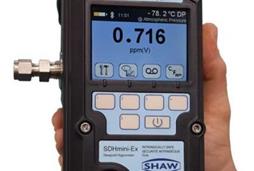
SHAW SDHmini and SDHmini-L
The SHAW SDHmini and SDHmini-L are handheld hygrometers with ±2 °C dewpoint accuracy and more than 150 hours of continuous operation from a fully charged battery.
The SDHmini-L can store up to 300,000 time-stamped readings and connects via Bluetooth, making it suitable for routine checks, commissioning and record keeping.
SHAW SDHmini-Ex
The SHAW SDHmini-Ex uses the same handheld design but is certified intrinsically safe to ATEX, IECEx and UL Class 1 Division 1 standards for use in hazardous areas.
SHAW SADP and SADP-D
The SHAW SADP and SADP-D are portable dewpoint meters for spot checks or continuous use on flowing air or gas.
They are certified intrinsically safe to ATEX and IECEx standards.
The SADP measures a sample at atmospheric pressure, with a maximum sensor head pressure of 0.3 barg.
Using a portable dewpoint meter on a pressurised line
Portable dewpoint meters generally measure at or close to atmospheric pressure.
On a pressurised air or gas line, use a SHAW sample system to reduce the pressure and control the flow before the sample reaches the meter.
SDH-PSS
SHAW designed the SDHmini Portable Sample System specifically for the SDHmini range of handheld hygrometers.
It conditions pressurised gas samples up to 200 barg, providing the correct sample pressure and flow for accurate dewpoint measurement.
SU2 and SU3
For the SADP and SADP-D portable dewpoint meters, the SU2 and SU3 sample plates include a pressure regulator and flow meter.
They condition the sample so that the dewpoint meter can measure under the required atmospheric conditions.
Choose an inline analyser for continuous monitoring
Choose an inline dewpoint analyser if you need continuous monitoring at one sample point, with a local display, alarms and an output to your control system.
An inline analyser remains connected to the process, providing operators with a live dewpoint reading, alarm relays and a signal for a PLC, SCADA or other control system.
Superdew 3 and Superdew 3 WP
The SHAW Superdew 3 and Superdew 3 WP are single-channel inline hygrometers with a measurement range of -100 °C to +20 °C dewpoint.
Both provide two alarm relays and a 4–20 mA output.
The instrument can be located more than 1,000 m from its sensor, allowing the display to be installed in a convenient control room or panel while the sensor remains at the measurement point.
The Superdew 3 WP is weatherproof and suitable for wall mounting.
AcuTrak
The SHAW AcuTrak is an inline hygrometer used with the AcuDew dewpoint transmitter.
It measures from -120 °C to +20 °C dewpoint with ±2 °C accuracy.
It provides two programmable alarm relays, a 4–20 mA retransmission output and RS485 communications.
This makes it suitable where local indication and control system integration are both required.
Choose a dewpoint transmitter for PLC, SCADA or BMS integration
Choose a dewpoint transmitter if you only need to send a dewpoint signal to an existing PLC, SCADA or building management system.
A transmitter provides a 4–20 mA signal and does not normally have a display or alarms of its own.
It is the simplest and most compact way to add continuous monitoring to a system that already handles data logging, display and alarms.
AcuDew
The SHAW AcuDew is a two-wire, loop-powered dewpoint transmitter with a linear 4–20 mA output.
It measures from -120 °C to +20 °C dewpoint and can withstand pressures up to 350 bar.
It can transmit over distances of up to 1,000 m without signal loss.
An AcuLoop plug-in display, AcuTrak display or AcuVu display can be added later if local indication is required.
SDT-Ex
The SHAW SDT-Ex is an isolated 4–20 mA dewpoint transmitter for hazardous areas.
It is certified intrinsically safe to ATEX and IECEx when installed with a suitable signal isolator.
About the aluminium oxide dewpoint sensor
The SHAW sensor uses ultra-high capacitance aluminium oxide sensing technology.
It is certified intrinsically safe to ATEX and IECEx standards.
The sensor measures from trace moisture levels up to ambient conditions, resists contamination and requires little routine maintenance.
Dewpoint meter vs transmitter: which should you choose?
Choose a portable dewpoint meter if you need to check several sample points.
Choose an inline dewpoint analyser if you need continuous monitoring with a local display and alarms.
Choose a dewpoint transmitter if your PLC, SCADA or BMS already provides those functions.
Still not sure? Many sites use both approaches
Many sites use both approaches.
A fixed transmitter or analyser monitors a critical process continuously, while a portable dewpoint meter is used to check other points and verify the fixed reading.
Whichever option you choose, the correct sample system is important where sample conditioning is required.
The SU4 sample conditioning unit or SWS-SD3 weatherproof sample system helps ensure that the gas reaches the sensor at the correct flow and pressure.
Our team can help you compare a dewpoint meter and transmitter for your application.
Call +44 1274 733582 to speak with a moisture measurement specialist.
Dewpoint meter vs transmitter FAQs
What is the difference between a dewpoint meter and a transmitter?
A dewpoint meter provides a direct reading, either on a portable instrument or an inline analyser.
A transmitter sends a 4–20 mA signal to a PLC, SCADA or BMS and normally has no display or alarms of its own.
When should I choose a dewpoint transmitter?
Choose a dewpoint transmitter when you need continuous measurement and your control system already displays the reading, logs the data and raises alarms.
When is a portable dewpoint meter the better choice?
A portable dewpoint meter is best suited to spot checks at multiple sample points, commissioning, troubleshooting and validating fixed instruments.
Can a portable dewpoint meter measure a pressurised line directly?
Portable dewpoint meters are generally intended to measure at or close to atmospheric pressure.
Use a suitable sample system, such as the SDH-PSS, SU2, SU3, SU4 or SWS-SD3, to reduce pressure and control the sample flow.
What sensor technology does SHAW use?
SHAW dewpoint instruments use ultra-high capacitance aluminium oxide sensor technology for trace moisture measurement in compressed air and industrial process gases.
Visit the Shaw Moisture Meters (UK) Ltd website for more information on Dewpoint meter vs transmitter
ENQUIRY FORM